 Presence of foreign material within the nostril
CONTRAINDICATIONS
 If the foreign body entered the nose traumatically and there is concern it has penetrated the cranial cavity
 If there is danger of obstructing the airway
 General Basic Steps
 Patient preparation
 Anesthesia
 Choose method of removal
TECHNIQUE
 Patient Preparation
 An uncooperative child should be properly immobilized or sedated
 An option is to papoose the child in a blanket in the supine position with the arms at the sides and an assistant holding the head still
 Using a syringe as a dropper, instill either lidocaine and phenylephrine or lidocaine with epinephrine in the nostril to optimize the visual field and provide anesthesia, decongestion, and hemostasis
 Dosing for nasal phenylephrine
 6 months to 2 years: 1 to 2 drops per nostril of a 0.1255 solution
 2 to 6 years: 2 to 4 drops per nostril of a 0.1255 solution
 Older than 6 years: 2 to 3 drops per nostril of a 0.1255 solution
 Make sure you have a good light source and suction
 Consider anxiolysis or sedation in the uncooperative child, especially in those who require more urgent removal of the foreign body, as in the case of button batteries
Methods of removal |
Manual removal |
Suction catheter |
Positive pressure |
Foley catheter |
Cyanoacrylate glue |
Nasal wash |
 Manual Removal
 A directly visualized object can be removed with alligator forceps or a curette with or without the assistance of a nasal speculum
 Alligator forceps are best used for easily grasped, solid or compressible (e.g., paper) objects in the anterior nostril
 A round and smooth object may be removed with an angled wire loop/curette or right-angle hook. It is inserted along the nasal floor or septum until it is behind the object and rotated so that the angled end is caught behind the object; the object can then be pulled out (FIGURES 87.1 and 87.2).
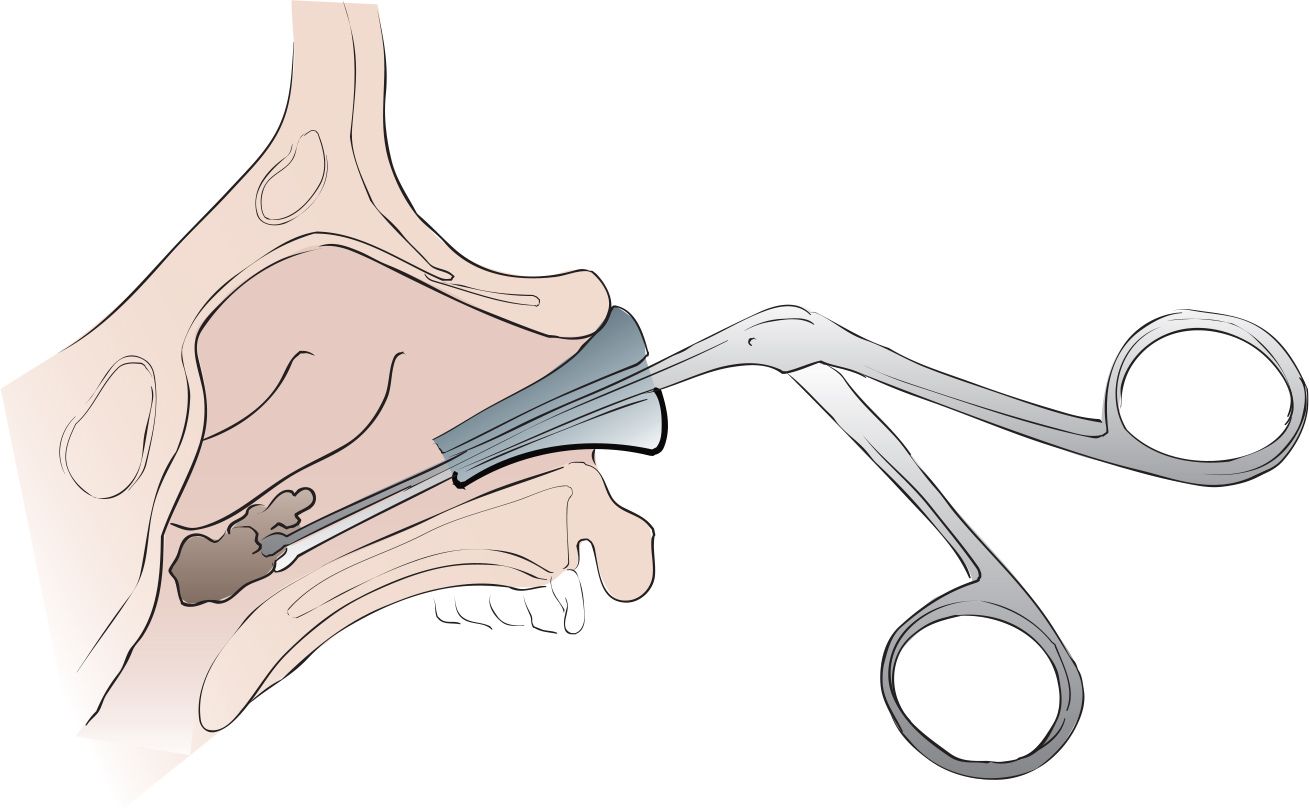
FIGURE 87.1 Removal of an intranasal foreign body using forceps. (From Issacman DJ, Post JC. Nasal foreign body removal. In: Henretig FM, King C, eds. Textbook of Pediatric Emergency Procedures. Philadelphia, PA: Williams & Wilkins; 1997:684, with permission.)
 If no wire loop is available, a makeshift one can be constructed with a paperclip (FIGURE 87.3)
 Suction Catheter
 Using a small suction catheter connected to wall suction, gently put the suction catheter up to the visible side of the object
 Be careful not push the object further back
 When the object becomes attached to the end of the suction catheter, slowly withdraw both the catheter and the foreign body
 Rigid suction catheters usually work better than flexible catheters
 The presence of side holes will prevent the vacuum from occurring at the tip. Choose a catheter without side holes, or trim the catheter tip to remove the side holes, leaving only an end opening.
 Trim any sharp edges from the cut end to prevent trauma
 Positive Pressure
 The parent or the physician can do this technique. The parent may assist with this procedure and therefore reduce the child’s anxiety.
 Instruct the parent to gently occlude the nostril without the foreign body with finger pressure
 Give one quick puff of air into the child’s mouth
 To put the child at ease, the parent can say she/he is going to give the child a big kiss
 The puff of air should push the foreign body out of the nostril



Full access? Get Clinical Tree


