 To provide temporary analgesia for intraoral or facial pain related to the following:
 Trauma requiring intraoral or facial laceration repair
 Dental trauma resulting in fractured teeth
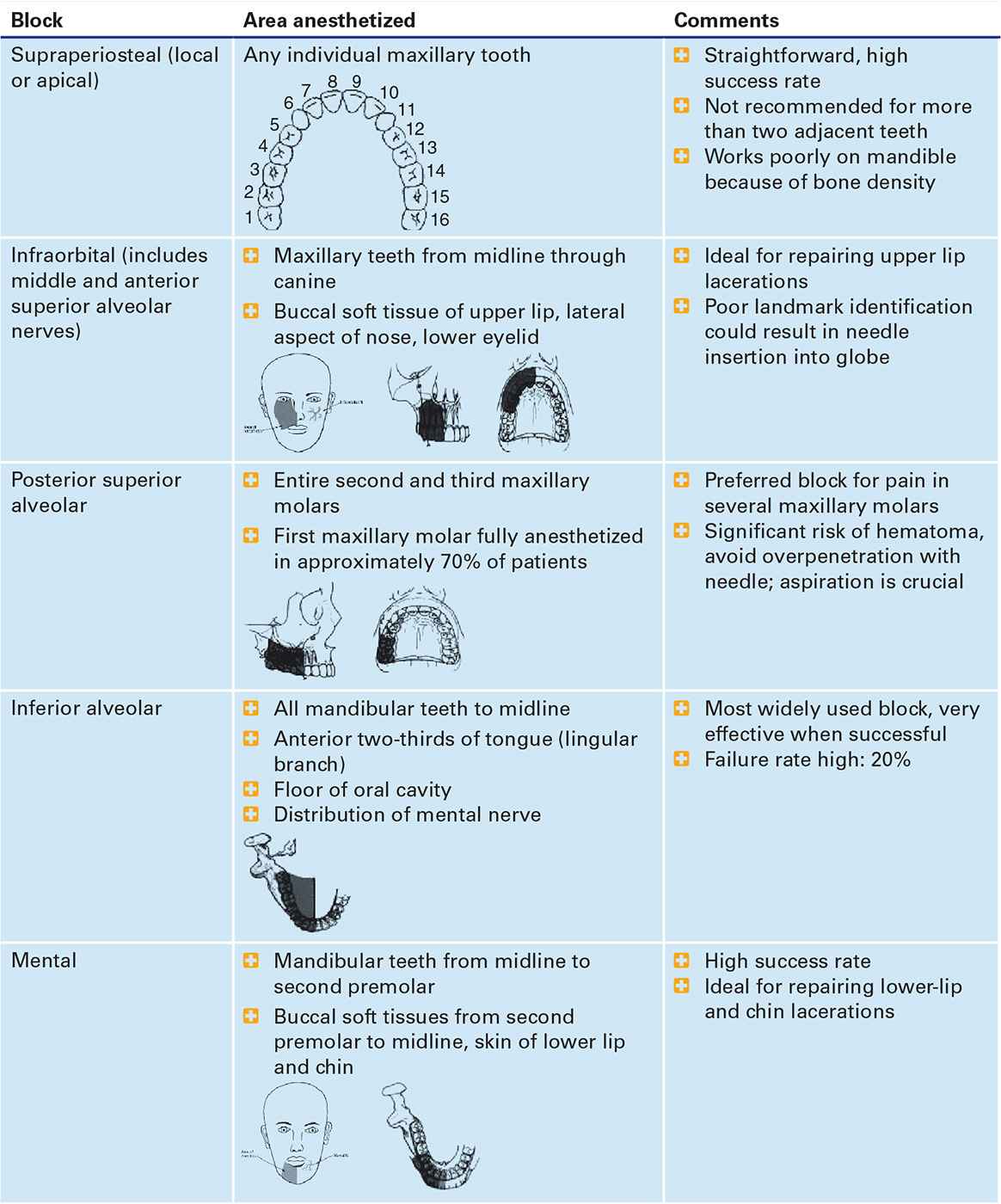
 Infection (tooth abscess, root impaction, gum disease) (TABLE 79.1)
CONTRAINDICATIONS
 Absolute Contraindications
 Hypersensitivity/allergic reaction to local anesthetic agents
 Relative Contraindications
 Coagulopathy
 Uncooperative or obtunded patients
LANDMARKS AND TECHNIQUE
 Equipment and Patient Positioning
 Adjust examination chair to accommodate patient height
 Ensure adequate lighting to visualize oral landmarks
 Assemble the necessary tools
 Sterile “thumb-control” Monoject aspirating dental syringe
 1½-inch 25- to 27-gauge needle
 Carpule cartridges containing anesthetic (either 2% lidocaine or 0.5% bupivacaine each with epinephrine 1:100,000 and 1:200,000 respectively)
 Cotton-tipped applicators for administering topical anesthetic and controlling bleeding
 Apply topical anesthetic (20% benzocaine or 5% to 10% lidocaine ointment) to mucosa before injection
 Use lidocaine for laceration repairs and bupivacaine for dental blocks; 0.5% bupivacaine provides roughly 1 to 3 hours of dental pulp analgesia and 4 to 9 hours of soft-tissue analgesia
 Buffering with bicarbonate is not recommended
SUPRAPERIOSTEAL NERVE BLOCK
 Apply topical anesthetic to apex of mucobuccal fold adjacent to the affected tooth
 Lift the patient’s upper lip and pull the tissue taut
 Orient needle and syringe parallel to the long axis of the tooth
 Insert needle into the target area with the bevel facing the bone
 Advance and aspirate until the needle is a few millimeters beyond the apex of the tooth
 If aspiration is negative then inject approximately 2 mL of anesthetic (FIGURE 79.1)
INFRAORBITAL NERVE BLOCK
See Chapter 80 (Facial Nerve Blocks)
POSTERIOR SUPERIOR ALVEOLAR NERVE BLOCK
 Apply topical anesthetic to apex of mucobuccal fold above the second maxillary molar
 Have the patient partially open the mouth and deviate the mandible toward the side of the pain to create more room
 Use your index finger to retract the patient’s cheek on the side being injected and pull the tissue taut
TYPES OF DENTAL BLOCKS |



Full access? Get Clinical Tree


